At GenAI-Training, compassion fuels our code. We’re not just passionate about Generative AI we’re immersed in it, driven by a mission to build solutions that uplift, empower, and inspire. Every project we take on is a blend of innovation and empathy, designed to solve real-world problems with cutting-edge intelligence. From smart automation to transformative AI tools, we’re shaping a future where technology serves humanity not the other way around.
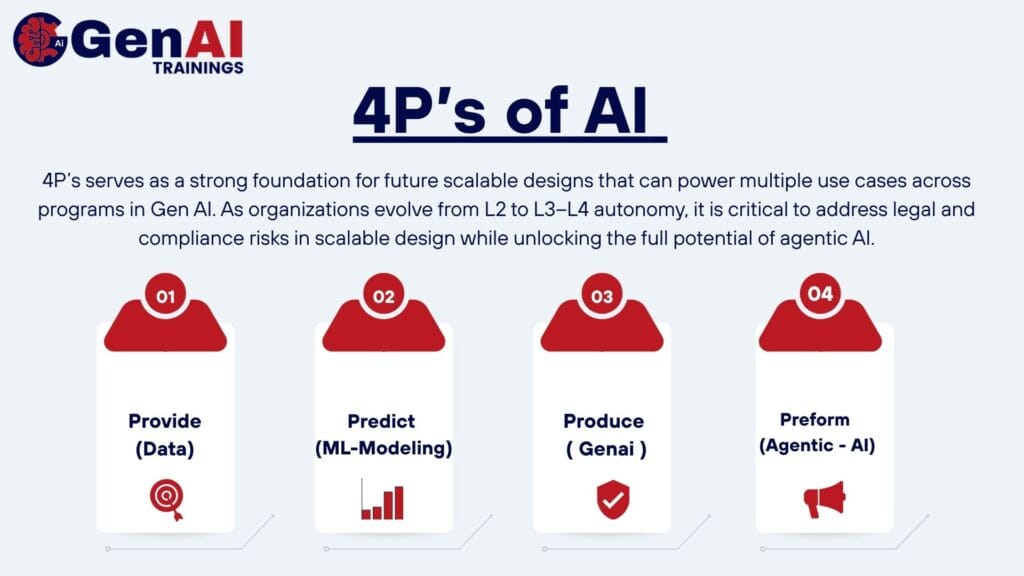
Genai Trainings The 4P’s of AI framework Provide, Predict, Produce, and Perform is a strategic maturity model designed to help organizations systematically unlock enterprise value from artificial intelligence. Provide focuses on delivering trusted, AI-ready data and contextual intelligence to empower informed decision-making. Predict leverages advanced analytics and machine learning to anticipate trends, risks, and opportunities with precision. Produce enables the creation of new content, code, designs, and solutions through Generative and Agentic AI systems, accelerating innovation and operational efficiency.
Finally, Perform represents the highest level of AI maturity where autonomous, self-optimizing systems continuously execute, adapt, and drive measurable business outcomes. Together, the 4P’s establish a scalable roadmap that transitions enterprises from insight driven AI adoption to performance driven intelligent transformation
This project is a Retrieval-Augmented Generation (RAG) based application designed to provide context-specific answers from a user-provided PDF document. The core functionality of the system revolves around restricting responses strictly to the contents of the uploaded PDF.
PDF Upload: Users upload a PDF file related to a specific domain (e.g., research paper, technical manual, textbook).
Contextual Question Answering: Users can ask questions, and the system retrieves and generates answers solely from the content of the uploaded PDF.
Scope Restriction: If a user asks something outside the scope of the PDF, the system responds with a predefined message like:
"This information was not found in the uploaded PDF."
This ensures that the application remains accurate, reliable, and domain-focused, making it ideal for academic, professional, or technical use cases where off-topic or hallucinated answers must be avoided. Try it out!
This project is an AI-powered translation application designed to provide accurate and efficient language translation for user-provided text. The system leverages advanced language models to translate input text into a user-selected target language.
Language Selection: Users can choose from a variety of supported languages for translation.
Text Input: Users enter the text they want to translate.
AI-Based Translation: The system uses artificial intelligence to provide fluent and context-aware translations into the selected language.
This application ensures quick, reliable, and intelligent translations, making it suitable for communication, learning, and content localization across different languages and cultures. Try it out!
This project is an animal classification application that uses the K-Nearest Neighbors (KNN) algorithm to identify and classify animals based on input features. It is designed to provide accurate classification results by comparing the input data with known labeled animal data.
Feature Input: Users input various features of an animal (such as size, habitat, diet, etc.).
KNN-Based Classification: The system uses the KNN model to classify the animal by finding the most similar entries in the training dataset.
Instant Results: The application quickly returns the predicted class or type of the animal.
This application provides a simple, efficient, and interpretable way to classify animals, making it useful for educational tools, biology-related studies, and machine learning experimentation. Try it out!
This project is an AI-based recruitment assistant designed to evaluate the relevance of a candidate’s resume against a specific job description. It streamlines the pre-screening process by analyzing both documents and providing intelligent insights. Try it out!
Resume and Job Description Input: Users upload a candidate's CV and paste the job description of the applied role.
Candidate Profile Analysis: The system reviews the candidate's resume to extract and summarize key qualifications, skills, and experience.
Job Requirement Matching: It compares the candidate’s profile with the job description to assess how well they align.
Automated Interview Questions: Based on the analysis, the application generates tailored interview questions to further evaluate the candidate.
This application enhances recruitment efficiency and decision-making by offering an intelligent, consistent, and fast evaluation of candidate suitability for a given role.